Quick Facts
- Delivery: On-campus
- Credits: 33
Our master's program in sport and exercise psychology is designed to offer students a well-rounded educational experience in the field of Sport and Exercise Psychology. We focus on preparing students to be competitive applicants for doctoral programs by offering them research and applied opportunities of interest, using a scientist-practitioner approach. Besides pursuing doctoral studies, students from our sport and exercise psychology program have also created their own private practice, worked with the military, got jobs in athletic academic advising, or worked as therapists.
We also have partnerships with the Counseling Psychology and Psychological Sciences departments, which allow students to apply for a dual degree in clinical mental health counseling, rehabilitation counseling, or social or clinical psychology, or to minor in one of these areas. Students can also add courses/minors related to coaching, strength and conditioning, biomechanics, nutrition, or neuroscience.
Our master's in sport and exercise psychology program offers the opportunity for students to work towards certification as a mental performance consultant through the Association for Applied Sport Psychology.
Additionally, we encourage students to be involved in research projects in order to gain experience with manuscript submissions, conference presentations, and grant writing, along with service work to be active citizens of the University, profession, and community. We strongly encourage membership in at least one national organization related to the sport and exercise psychology field as well as attendance at a related state, regional, or national conference.
Our MS/MA in Sport and Exercise Psychology program ranked #8 on Psychology Degree 411's recently launched list of the Most Affordable Sport Psychology Master's Programs.
If you are interested in receiving services related to mental performance, please contact Dr. Jean Charles Lebeau or Dr. Lindsey Blom. If you have received services payments can be made here.
During the first semester, students learn the foundations they need in Sport and Exercise Psychology (SEP), and during the second semester, applied work and research begins. Doing a M.S in SEP at Ball State means being part of a very tight-knit and supportive community, and faculty challenge and encourage students to grow both as a consultant and as a person. Students in the program spend time together playing sports, going to sporting events, and collaborating on research and applied work. The classes students in the sports and psychology master's program take provide opportunities to get real-world experience with multiple populations.
At Ball State, students have the opportunity to work with a wide variety of clients including, but not limited to, NCAA Division I student-athletes, club sport teams, youth athletes, military students, exercisers, injured athletes, e-sports and performing art students. Many Ball State teams regularly choose to have a student in the Sport and Exercise Psychology program work with their team, and students are also encouraged to pursue working with individual clients. Students take the main practicum course in their second semester and have the opportunity each semester to continue working with clients if they choose. Students doing applied work are mentored by Dr. Blom or Dr. Lebeau and can count their applied hours toward the Mental Performance Consultant Certification delivered by the Association for Applied Sport Psychology.
If you have received services payments can be made online.
Our program offers ample research opportunities. Students assist professors, assist each other, do their own work, and complete a thesis/research project. Students can get experience in qualitative and quantitative methodology, as well as lab and applied research.
We also support students to attend professional conferences and help them obtain opportunities to present research and write grant proposals. Recent students have presented at the European Congress of Sport and Exercise Psychology (FEBSAC), Association for Applied Sport Psychology national conference (AASP), American Psychological Association (APA), Midwest Sport and Exercise Psychology Symposium (MSEPS), the American College of Sports Medicine (ACSM) meeting, and the U.S. Center for Coaching Excellence summit (USCCE). Recent student work has been published in the Journal of Sport for Development, the Journal of Sport Behavior, The Physical Educator, The Sport Psychologist, International Journal of Exercise Science, and Psychological Reports.
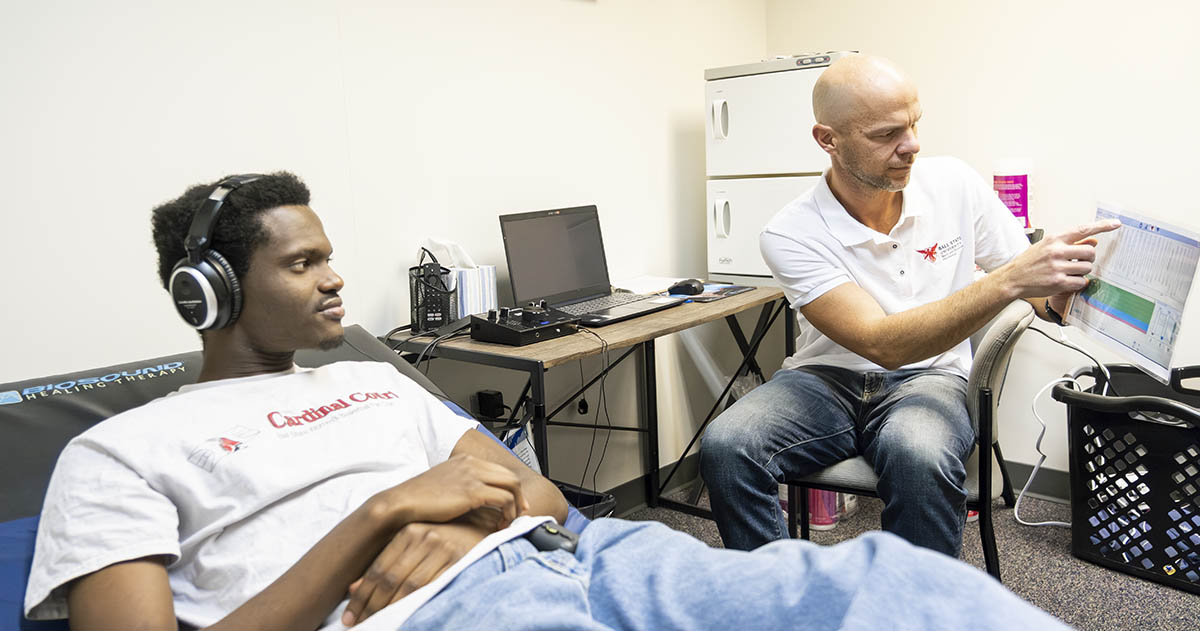
The Sport and Exercise Psychology lab is a multipurpose space for students to utilize during the course of their graduate work. The Lab serves as a functional area used for mental skills presentations with athletic teams, student and faculty research, class projects, group meetings, and as a collaborative place of study. The Lab is equipped with a variety of tools for assessing and improving athletes’ and exercisers’ performance, such as biofeedback, mindfulness training tools, and virtual reality equipment. The Lab also consists of many innovative apparatus used in research, such as a recumbent bike, elliptical, iPads, video recording, exergaming, and various research-related software.
- What Can You Do with a Master’s Degree in Sport and Exercise Psychology?
Students work in a variety of different jobs depending on their career interest.
Many have gone on to:
- work in the military using performance psychology (which is the highest employer of master-level SEP practitioners)
- private practice
- athletic academic advising
- student athlete development
- coaching
- wellness
- athletic training
- physical therapy
Others have also gone into work in nonprofit, fitness, and counseling settings.
- If I want to do the dual degree option, should I apply to both programs?
Both options are good. You can either apply to both programs or apply to one and once you are accepted you can apply to the other program in the Spring of your first year. This will not delay your graduation timeline (3 years for the dual degree option)
Cognate in Sport and Exercise Psychology
Are you a master's student or doctoral student interested in sport and exercise psychology? Add the Sport and Exercise Psychology minor or cognate to your plan of study and gain knowledge and skills in theory and research. Our program prepares you for conducting mental skills consulting with coaches, athletes, parents, fitness professionals, and military personnel. Use your expertise to enhance performance and enjoyment in sports and physical activity.
Minor in Sport and Exercise Psychology
Eligible graduate students can add a Sport and Exercise Psychology (SEP) minor to their plan of study. The SEP minor allows students to learn about theory and research used to educate coaches, athletes, parents, exercisers, fitness professionals, and tactical populations about the psychological aspects of sport and physical activity used to facilitate optimal involvement, performance, and enjoyment. The minor requires a minimum of 15 credit hours. Students must have at least a 3.0 GPA and be in good academic standing.
Program Mission and Goals
Our overarching mission surrounds four main areas that align with the Ball State beneficence pledge:
1) To maintain high standards of scholarship and excellence,
2) To practice academic honesty,
3) To act in a socially responsible way by treating each person in the Ball State community with civility, courtesy, compassion, and dignity, and
4) To value the intrinsic worth of every member of the community, respecting and learning from differences in people, ideas, and opinions.
We strive towards our overarching mission by offering students a well-rounded educational experience in the field of Sport and Exercise Psychology. We focus on preparing students to be competitive applicants for doctoral programs as well as applied careers by offering both research and applied opportunities of interest, using a scientist-practitioner approach.
Our overarching goal is to prepare our students to be strong and ethical scientist-practitioners who integrate research and theories into their research and applied work. We achieve this through a team atmosphere, a myriad of professional development opportunities, and small cohorts for individualized mentoring of students' research and applied work.
We have two main goals:
- Our first goal is to provide students with a variety of applied opportunities (e.g., DI and DIII teams and individuals, esports, performing artists, youth sports, exercisers, injury rehabilitation, ROTC, and community youth organizations) so they can experience the gamut of possibilities in the field of Sport and Exercise Psychology. Through these experiences, students work with CMPC mentor-approved faculty to be exposed to different mentorship relationships.
- Our second main goal is to develop our students’ research skills. We require all students to conduct a research project with data collection as part of their graduation requirement. Conducting a research study allows them to gain experience in developing a research question, conducting an extensive literature review, working with IRB, collecting and analyzing data, and writing a discussion and implications. We encourage students to also be involved in other research projects to gain further experience in the manuscript submission process, as well as present at a professional conference, and be part of writing a grant. We strongly encourage membership in at least one national organization related to the Sport and Exercise Psychology field as well as attendance at a related state, regional, or national conference.
To reach those goals, students completing the Sport and Exercise Psychology graduate program will:
- Synthesize literature, formulate a research project, and conduct a research study,
- Present research findings,
- Participate in professional development activities in the field of Sport and Exercise Psychology, such as attending a conference,
- Demonstrate basic consultation skills, including active listening, rapport building, motivational interviewing, and taking case notes,
- Demonstrate the ability to design, implement, and evaluate the effectiveness of psycho-social mental skills interventions and techniques.
Students completing the Sport and Exercise Psychology graduate program will:
- synthesize literature, formulate a research project, and conduct a research study.
- participate in professional development activities in the field of sport and exercise psychology.
- present research findings.
- demonstrate basic consultation skills, including active listening, rapport building, motivational interviewing, and taking case notes.
- demonstrate the ability to design, implement, and evaluate the effectiveness of psycho-social mental skills interventions and techniques.
Keep Exploring
Take the Next Step
If you’d like to learn more about our Master's in Sport and Exercise Psychology degree, complete our online form or contact us for more information. And if you’re ready to apply, review our admission requirements and complete our online application.